We are pleased to present NEBULA, the knowledge repository for ESA's R&D programmes — a portal in which we have been actively involved in the software development and UI/UX redesign.
NEBULA aims to make information about the agency's R&D projects accessible — including executive summaries of each activity — to any company, researcher or institution working within the European space ecosystem.
The portal began with activities from ESA's Discovery and Preparation element, publicly accessible since the early 2000s. Since 2021, ESA has been progressively incorporating activities from the Technology Development Element (TDE), the GSTP programme and other lines of research, so the portfolio grows continuously as projects close and their deliverables are approved.
The portal offers three modes of exploration: multi-programme search, advanced search with detailed filters, and a timeline view to navigate projects across their temporal dimension.
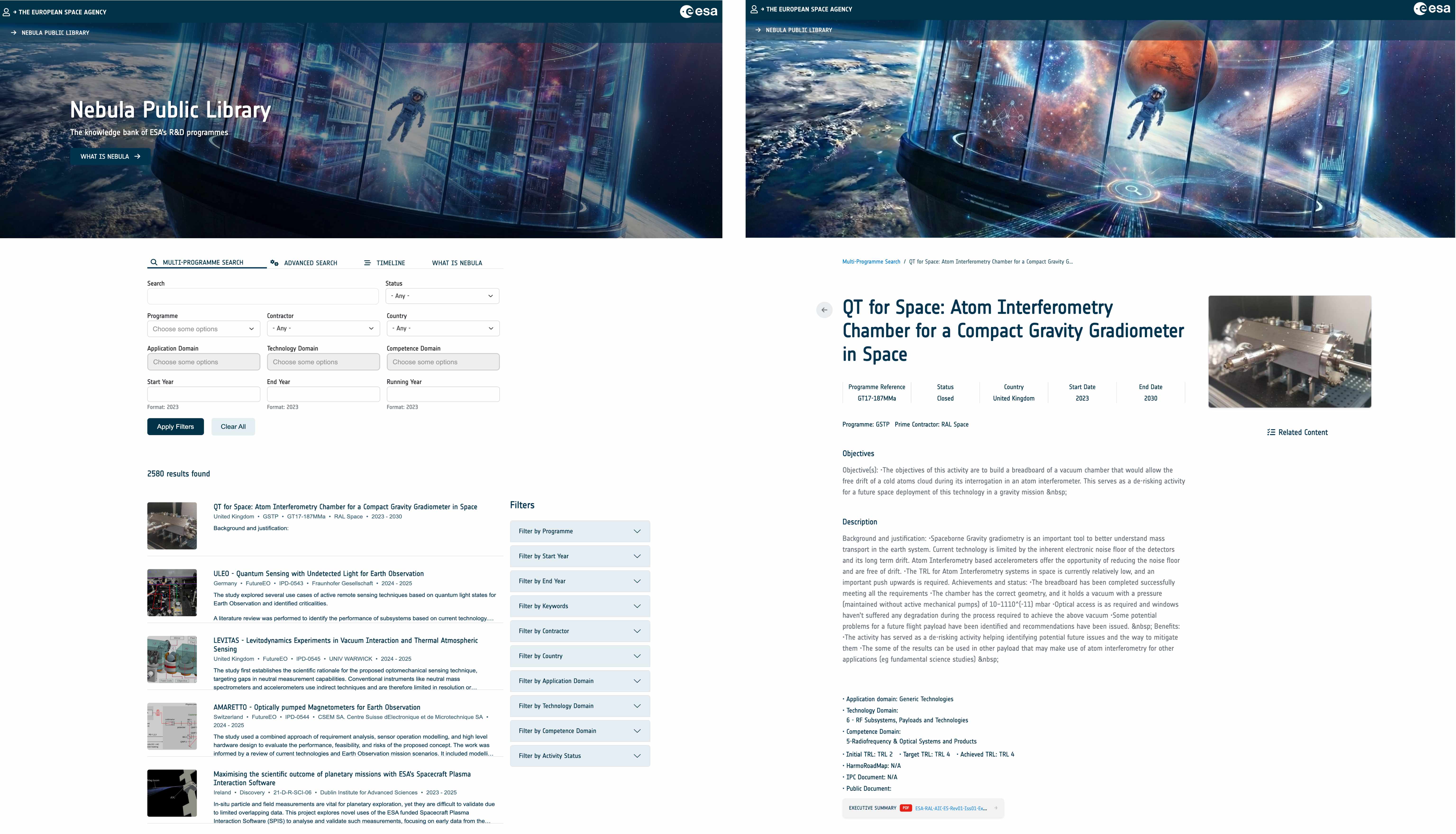
One of NEBULA's central purposes is to ensure that the knowledge and experience generated in each project is available for future work — avoiding unnecessary duplication and allowing interested industry to benefit from the results, find partners and identify competences within the sector.
In practice, this means that a European contractor can consult what has already been researched on a specific technology before proposing a new study. It is shared knowledge that accelerates innovation in the space sector.
This project has involved software development activities and a redesign of the portal's user interface, with the aim of improving the experience for all user profiles: from ESA's internal researchers to industry players consulting public results.
The portal is built on Drupal 10 and uses Apache Solr as its search engine. As is standard for this type of solution, the portal integrates with ESA's corporate systems for user authentication via Single Sign-On (SSO), and with Matomo for traffic analytics.
Among the most technically significant aspects of the project are the implementation of a REST API for study management and integration, a dual-environment architecture — internal and public — with a controlled publication workflow, and the homogenisation of studies from different ESA R&D programmes.
We are proud to have contributed to making this resource clearer, faster and easier to use for the entire European space community.
The portal is publicly available at nebula.esa.int. We encourage you to explore it — whether you work in the space sector or simply wish to discover the breadth of research that ESA makes available to all.
This activity is carried out under a programme of, and funded by, the European Space Agency. The views expressed in this publication can in no way be taken to reflect the official opinion of the European Space Agency.